
Giuseppe Verdi
Aida
Sep 21 – Jun 12

Price includes $10.00 fee
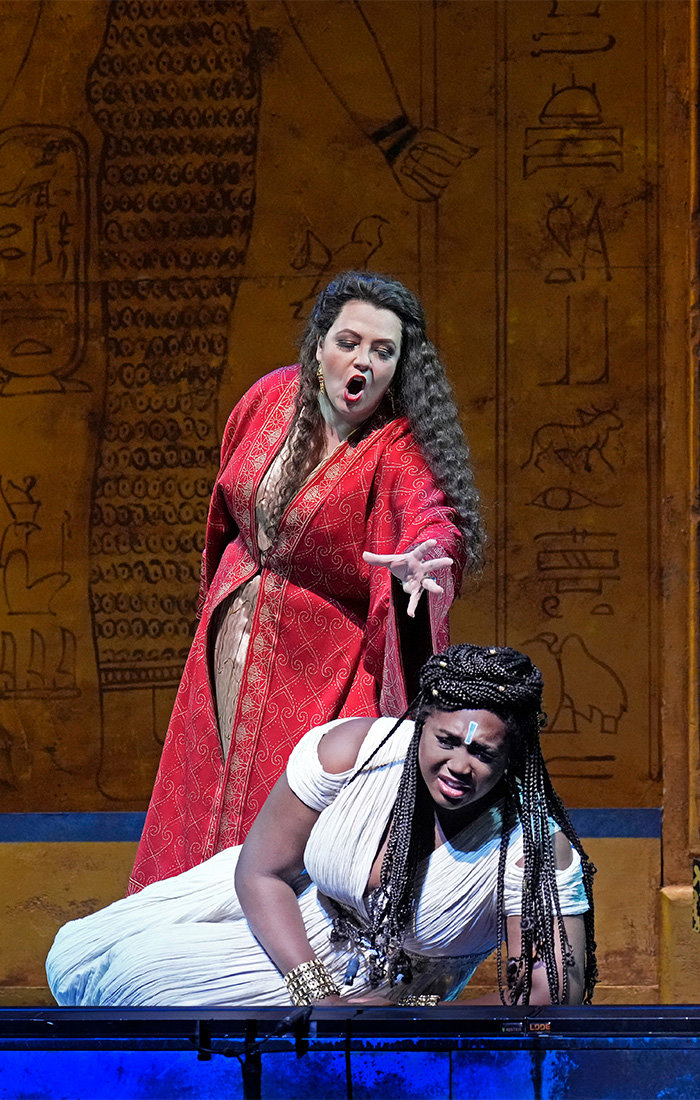
Hailed by the Financial Times as “an ingenious Aida,” Tony Award–winner Michael Mayer’s breathtaking production brings ancient Egypt to life with towering scenery and dazzling animated projections. Soprano Angel Blue reprises her celebrated portrayal of the title role, trading off with Anna Pirozzi and Leah Hawkins. Tenors Michael Fabiano and SeokJong Baek alternate as Aida’s forbidden lover, with mezzo-sopranos Judit Kutasi and Olesya Petrova as the imperious princess who comes between them.
Production sponsored by C. Graham Berwind, III
Revival a gift C. Graham Berwind, III
The Met gratefully acknowledges the support of Mastercard, the official payment partner of the Metropolitan Opera
Sung In
Italian
Met Titles In
- English
- German
- Spanish
- Italian
Estimated Run Time
3 hrs 15 mins
House Opens
Acts I and II
90 mins
Intermission
30 mins
Acts III and IV
75 mins
Opera Ends
Cast

Conductor
Daniele Callegari
Performing
Mar 9, 13, 17, 20, 25, 29
Apr 2, 6, 9, 10, 13, 15, 18, 23

Conductor
Marco Armiliato
Performing
Sep 21
May 15, 22, 28, 30
Jun 6

Conductor
John Keenan
Performing
Jun 12

Aida
Angel Blue
Performing
Mar 9, 13, 17, 20, 25, 29
Apr 2, 6, 10, 15

Aida
Anna Pirozzi
Performing
Apr 9, 13, 18, 23

Aida
Leah Hawkins
Performing
Sep 21
May 15, 22, 28, 30
Jun 6, 12

Amneris
Judit Kutasi
Performing
Mar 9, 13, 17, 20, 25, 29
Apr 2, 6, 10, 15

Amneris
Olesya Petrova
Performing
Sep 21
Apr 9, 13, 18, 23
May 15, 22, 28, 30
Jun 6, 12

Radamès
Michael Fabiano
Performing
Mar 9, 13, 17, 20, 25, 29
Apr 2, 6, 10, 15

Radamès
SeokJong Baek
Performing
Sep 21
Apr 9, 13, 18, 23
May 15, 22, 28, 30
Jun 6, 12

Amonasro
Quinn Kelsey
Performing
Mar 9, 13, 17, 20, 25, 29
Apr 2, 6, 10, 15

Amonasro
George Gagnidze
Performing
Apr 9, 13, 18, 23
May 15, 22, 28, 30
Jun 6, 12

Amonasro
Michael Chioldi
Performed
Sep 21

Ramfis
Alexander Köpeczi
Performing
Mar 9, 13, 17, 20, 25, 29
Apr 2, 6, 9, 10, 13, 15, 18, 23

Ramfis
Soloman Howard
Performing
Sep 21
May 15, 22, 28, 30
Jun 6, 12

King
Huanhong Li
Performing
Mar 9, 13, 17, 20, 25, 29
Apr 2, 6, 10, 15

King
Harold Wilson
Performing
Apr 9, 13, 18, 23
King
Krzysztof Baczyk
Performing
Sep 21
May 15, 22, 28, 30
Jun 6, 12

World premiere: Khedivial Opera House, Cairo, 1871. This grandest of grand operas features an epic backdrop for what is in essence an intimate love story. Set in ancient Egypt and packed with magnificent choruses, complex ensembles, and elaborate ballets, Aida never loses sight of its three protagonists. Few operas have matched Aida in its exploration of the conflict of private emotion and public duty, and perhaps no other has remained to the present day so unanimously appreciated by audiences and critics alike.
Creators
In a remarkable career spanning six decades in the theater, Giuseppe Verdi (1813–1901) composed 26 operas, at least half of which are at the core of today’s repertoire. His role in Italy’s cultural and political development has made him an icon in his native country. The story of Aida is thought to be the creation of Auguste Mariette (1821–81), an extraordinary French archaeologist who was the founder of the Egyptian Museum of Cairo. Camille du Locle (1832–1903), who collaborated on the scenario with Mariette and suggested the story to Verdi, had worked with the composer on the libretto of Don Carlos. Aida’s librettist, Antonio Ghislanzoni (1824–93), was a novelist and poet as well as the creator of some 85 libretti.
-
composer
Giuseppe Verdi
Production
Michael Mayer
SET DESIGNER
Christine Jones
COSTUME DESIGNER
Susan Hilferty
LIGHTING DESIGNER
Kevin Adams
Projection Design
59 Studio
CHOREOGRAPHER
Oleg Glushkov
Production Consultant
Stephen Pickover
C. Graham Berwind, III Chorus Director
Tilman Michael
Setting

The libretto indicates merely that the opera takes place in “ancient Egypt, in the time of the pharaohs.” This may sound vague, but it was a clear direction to approach the drama as myth rather than anthropology or history.
Music
The score of Aida is a sophisticated example of Italian Romanticism, imbued with a convincingly mysterious and exotic hue. Making no claims to authenticity, Verdi created a unique musical palette for this opera. The grandeur of the subject is aptly conveyed with huge patriotic choruses, most notably the unforgettable Triumphal Scene in Act II. These public moments often serve as frames for the solos of the leading tenor and soprano: his soaring “Celeste Aida” right at the beginning of Act I, her impassioned “Ritorna vincitor!” that follows, and her great internal journey, “Qui Radamès verrà! … O patria mia” in Act III.

Share This Page
Social Share
Copied