
Giacomo Puccini
La Fanciulla del West
Dec 31 – Jan 30

Price includes $10.00 fee
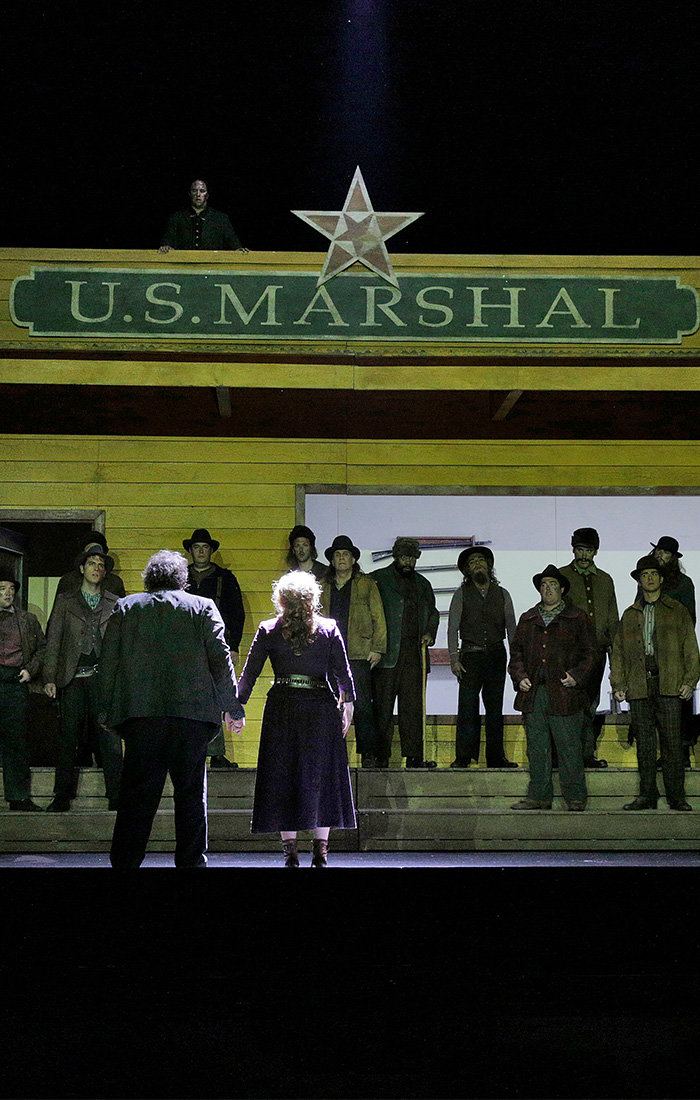
On New Year’s Eve 2026, Puccini’s exhilarating drama of the Wild West returns in a new staging by celebrated British director Richard Jones, marking the company’s first new production of La Fanciulla del West in more than 30 years. Soprano Vida Miknevičiūtė makes an important Met debut as the larger-than-life Minnie, the tough tavern owner with a heart of gold who finds love when she least expects it. Tenor SeokJong Baek is the dashing bandit who rambles into the remote California mining town to steal her heart, opposite baritone Christopher Maltman as the lawman determined to deliver rough justice—and win Minnie for himself. Maestro Keri-Lynn Wilson takes the podium to conduct one of opera’s most action-packed adventures.
Please note that video cameras will be in operation during the January 19 and 23 performances, as part of The Met: Live in HD series of cinema transmissions.
This production was originally created by English National Opera and The Santa Fe Opera
Sung In
Italian
Met Titles In
- English
- German
- Spanish
- Italian
Estimated Run Time
3 hrs
House Opens
Act I
65 mins
Intermission
35 mins
Acts II & III
80 mins
Opera Ends


World premiere: Metropolitan Opera, New York, 1910. Puccini’s “American” opera, based on David Belasco’s play The Girl of the Golden West, had its glamorous and highly publicized world premiere at the Metropolitan Opera, with the composer in the audience. The drama is set during the California Gold Rush, and the girl of the title is one of Puccini’s most appealing heroines—a strong, independent woman determined to win the man she loves. Although it fell out of favor with audiences for a few decades following its original success, Fanciulla has rebounded in popularity in recent years and is now counted among Puccini’s best works.
Creators
Giacomo Puccini (1858–1924) was immensely popular in his own lifetime, and his mature works remain staples in the repertory of most of the world’s opera companies. His operas are celebrated for their mastery of detail, sensitivity to everyday subjects, copious melody, and economy of expression. For the libretto of Fanciulla, Puccini’s publisher recommended the services of Carlo Zangarini (1874–1943), whose mother came from Colorado and who was fluent in English. Puccini found much of Zangarini’s work “truly beautiful” but was frustrated by how slowly he worked, so the author and journalist Guelfo Civinini (1873–1954) was brought in to collaborate. The source play, The Girl of the Golden West, was written and produced on Broadway by the American impresario David Belasco (1853–1931), who was also the author and producer of Madame Butterfly, which Puccini set just before Fanciulla.
-

composer
Giacomo Puccini

Production
Richard Jones

SET DESIGNER
Miriam Buether

COSTUME DESIGNER
Nicky Gillibrand

LIGHTING DESIGNER
Mimi Jordan Sherin

Choreographer
Lucy Burge

C. Graham Berwind, III Chorus Director
Tilman Michael
Setting

The opera unfolds in the mountains of California during the Gold Rush in 1849–50. The anachronistic presence of a Pony Express rider and a Wells Fargo agent would indicate a date after 1860, but historical accuracy is not the goal in this tale. Puccini was enchanted with Belasco’s fictional setting, with its combination of mythic and grittily realistic elements.
Music
With his international stature assured, Puccini explored new musical horizons in Fanciulla: There are few arias (the tenor’s Act III “Ch’ella mi creda” being a standout exception), and most of the music relies on changes of tone and color instead of set pieces. The orchestral sweep, appropriate to the dramatic landscape of the California mountains, is apparent in the first bars of the brief, explosive prelude. As in Tosca and Madama Butterfly, local musical elements are depicted for color, albeit sparingly. The score is marked by a preponderance of male voices, reflecting the title heroine’s isolation in an almost all-male world.

Share This Page
Social Share
Copied