
Art Imitates Life
When Asmik Grigorian made her Met debut in 2024, audiences flocked to see her star in Puccini’s Madama Butterfly as critics hailed her as “a fiercely intelligent and captivating singer” (The New York Times) and an artist “seemingly able to sing just about any role she chooses” (The Associated Press). The Lithuanian soprano is back this April as Tatiana, the lovestruck ingénue turned sophisticated princess in Tchaikovsky’s great Russian masterpiece Eugene Onegin. As she prepared for her eagerly awaited return, Grigorian spoke to the Met’s Christopher Browner about her deep personal connections to the role and previewed some exciting projects on the horizon.
You first appeared as Tatiana in 2012. Nearly 15 years later, what significance has this role played in your career?
I’ve had a long journey with this role, and while I haven’t sung it as frequently as some others, whenever I hear the music, it brings back very powerful memories. Even before I sang this opera, I already had a close emotional connection to the music because I heard it a lot in my childhood. The first time I actually sang Tatiana was with the Vilnius City Opera in my hometown, and my mother was singing the role of Filippyevna. It was the first show we did together, and my son was also performing in the production. Then, when I sang the role in Berlin a few years later, my father was very sick, so my time was split between the hospital and the rehearsal room. And I was pregnant with my daughter at the same time. It seems that something major is always happening in my life when I sing this role.
Your repertoire includes a long list of highly taxing soprano roles, from Salome and Turandot to Lady Macbeth and Norma. Taking on a more lyrical part like Tatiana must feel like a nice change.
It’s certainly not as technically demanding as some of the other roles I sing, so I’m able to enjoy the performances without too much stress. I think the true nature of my voice includes a lot of vulnerability, so to keep my voice healthy, I need to balance those heavier roles with more lyrical roles like Tatiana, so that I don’t lose flexibility and the ability to sing floaty, beautiful music. And as an artist, I think I would get bored only portraying ladies killing people.
What is special about Tchaikovsky’s vocal writing for Tatiana?
What I love is how he shows the inner journey Tatiana takes from being a young, inexperienced girl who falls in love with entirely the wrong person to a woman who knows what she wants and makes decisions for herself. And for me now at 44 years old, I feel that I still have enough lyrical colors in my voice for the youthful music and the Letter Scene, which is such a masterpiece. But I also have the power to sing the final scene, which is much more dramatic. It’s really one of my favorite Tchaikovsky operas. In every scene, I think, “My God, how many years have passed since this opera premiered, and yet nothing has changed? People still say these exact same things to each other.”
A scene from Deborah Warner’s production of Eugene Onegin
In addition to your singing, you’re recognized as one of the opera world’s most compelling actresses. What is your approach to creating a character on stage?
No matter the character, I play one woman: myself. I never want to think, “How would Tatiana react in this situation?”, because I have no clue. I can only put myself into the situation of the character and react organically. Sometimes people ask what I want to say with this role or that role, but my singing has never been a statement. My singing is more like going to confession. I’m naturally a very introverted person, and I have difficulty showing my emotions in everyday life. But on stage, I cannot lie. Finding this level of complete honesty is one of the most important things in any role I play.
Next season at the Met, you’ll take on a very different role—the harrowing title character of Janáček’s Jenůfa, who must grapple with her own abandonment and the death of her child.
When you first think about it, it does seem like they are two completely incomparable stories. But once I started performing one role after another, I understood that really the pain is the pain. From our perspective, they’re completely different, but for the person who is suffering, it’s the same. I think every woman, even if she doesn’t have children, can understand Jenůfa’s pain. But of course, life experience helps you better understand your characters, and for me as a mother, I can’t help but project this story onto my own kids. So that makes this role very difficult but also very special for me.
Also next season, you’ll join the very select group of artists to have presented a solo recital on the Met stage, accompanied by pianists Petras and Lukas Geniušas. What can audiences expect from that program?
The program includes music by Puccini, Dvořák, Verdi, and Strauss, but I don’t see it as a recital as much as a kind of mono-opera. Going back to the idea that I’m always playing the same woman—myself—I wanted to create a performance that’s really about one character and uses many different arias to tell her story. Lukas and I recently recorded an album of Rachmaninoff songs, and Petras is also a really great jazz pianist, so we might even reinterpret some of the music. It’ll be a little experimental, and we’re still figuring out the story, but I’m really looking forward to sharing it.
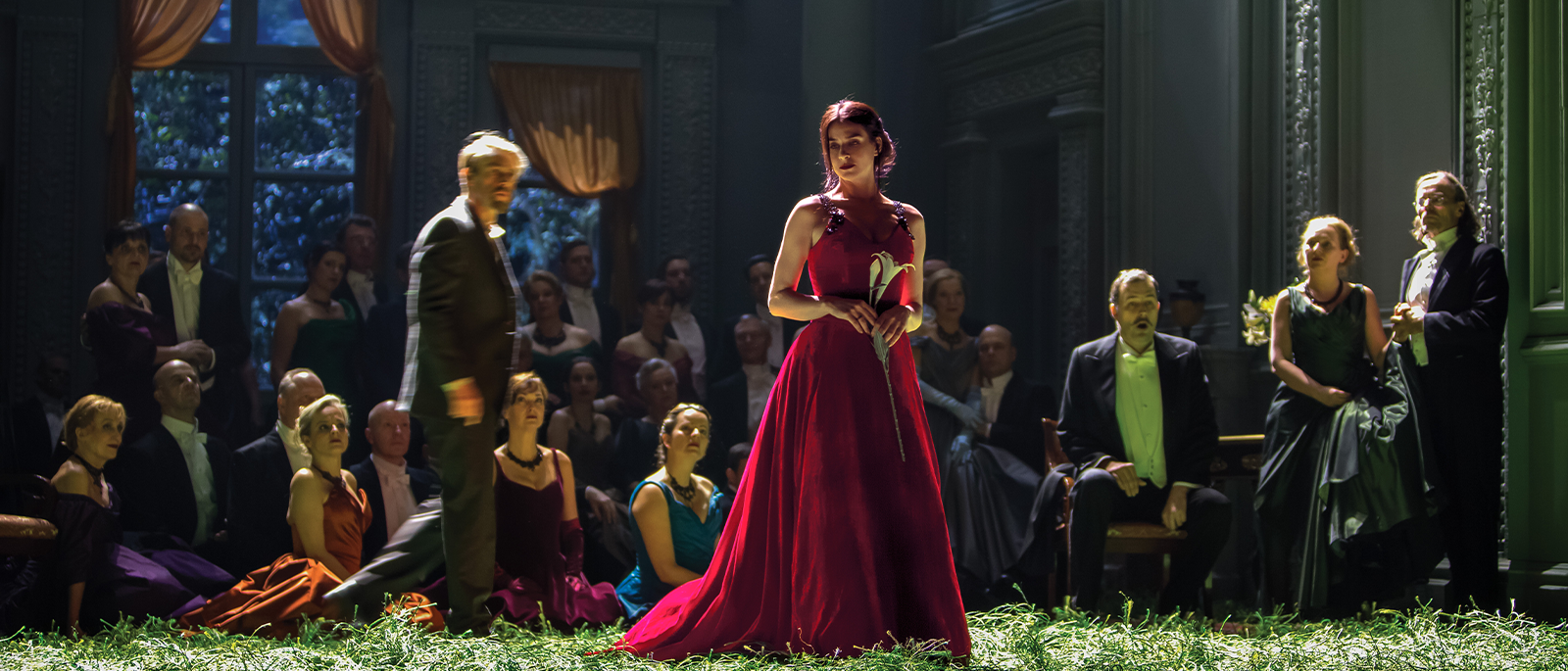
Pictured at top of page: Asmik Grigorian as Tatiana at the Komische Oper Berlin